A Family Gathering, One Story Worth Carrying Home
A family gathering story can grow from a familiar object. Learn how to honor a relative’s version, protect private memories, and carry home only what they share.
The common mistake at a family gathering is treating an old photograph like a prompt card: ask for the story, then collect names and dates. That can turn a relative’s memory into material for the table. A family gathering story works better when the photograph belongs to the person looking at it, not to everyone waiting for a tale.
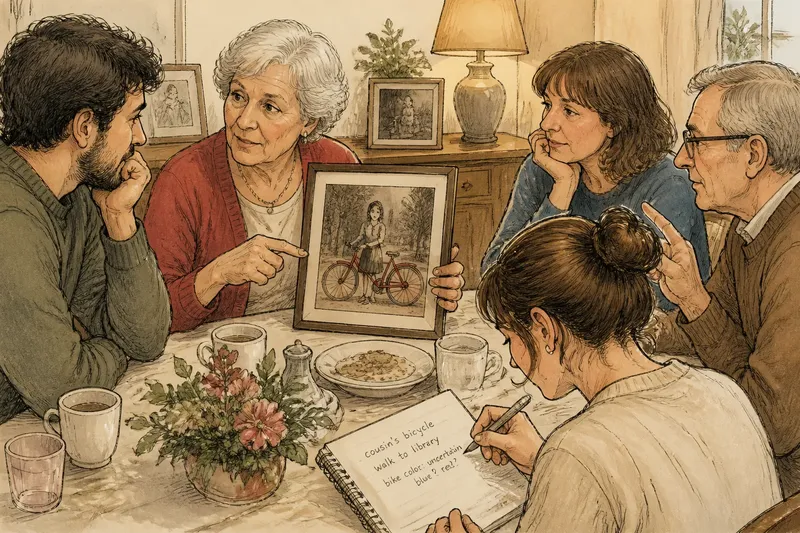
Imagine you are at your aunt Lena’s Sunday dinner. A framed picture on the sideboard shows her beside a red bicycle. You ask, “Would you like to tell me anything about this picture?” The question leaves room for a memory, a correction, or a simple “not really.” It also makes clear that no one owes the table a performance.
How can a photograph become shared context?
A visible detail gives the conversation something both people can notice, but it does not establish what the picture means. The bicycle might belong to Lena, a cousin, or a neighbor. Even a familiar face can carry a different memory for each person who sees it.
So begin with what is actually visible, then leave interpretation to the person who knows the moment. “I noticed the red bicycle” is safer than “That must have been your first bike.” The first offers an observation; the second quietly asks Lena to accept your version before she can give hers.
This distinction matters at family gatherings, where stories may have been retold until one account sounds official. A photograph can reopen the question of who remembers what. Let the picture anchor the exchange, not settle it.
What happens when memories disagree?
In this invented dinner scene, Lena says the bicycle belonged to her cousin, not to her. You accept the correction: “I had that wrong. What do you remember about the picture?” She says her cousin rode it to the library, while Lena walked beside her.
Another relative might remember the cousin’s bike as blue. Rather than call for a vote, you can make space for both accounts: “You remember it as blue, and Lena remembers going to the library with her. Do you both remember the same day?” The question makes the difference visible without forcing either person to surrender a memory.
Not every disagreement needs resolving. Family stories can mix separate occasions, inherited retellings, and details no one can verify. If the distinction matters for a practical reason, such as labeling an old photograph, say what remains uncertain. If it does not, the story can keep its loose edges.
How do you keep the story from becoming a family verdict?
A memory may touch a family dispute, an old hurt, or someone who is not at the table. The moment a story becomes evidence in an argument, the person telling it may lose control of its meaning. You can signal that you are listening without recruiting Lena to prove a point.
Say, “I hear that you remember it differently,” rather than “So that proves what happened.” If someone else starts correcting every detail, ask Lena whether she wants to continue or would rather leave it there. When the subject is sensitive, move the conversation away from an audience or let it end.
What is not worth the effort? Pressing for a perfect timeline when nobody needs one. A string of questions about dates, exact words, and who stood where can make a personal recollection feel like cross-examination. Keep only the details that serve the conversation or a purpose Lena agrees to.
What questions come up when a relative shares a memory?
What if I recognize the photograph but remember it differently?
Offer your version as a memory, not a correction: “I remember a blue bike, though I may be thinking of another day.” That gives your relative room to respond without making either account the official one.
Should I ask who else is in the picture?
Only if the question feels welcome and the answer serves the conversation. If your relative does not know, or changes the subject, let the identity remain uncertain rather than turning the picture into a search assignment.
What if the story involves someone who is not present?
Be careful about sharing claims or private details on that person’s behalf. If the memory is painful or disputed, ask whether your relative wants to discuss it here, and respect a wish to stop.
Can I write the story down afterward?
Ask before recording or sharing a personal account, and distinguish your notes from your relative’s exact words. If permission is unclear, keep the memory private or leave it unwritten.
How can you carry a story home without taking it over?
Say what stayed with you, without polishing it into a family legend: “I liked hearing how you and your cousin walked to the library.” If you want to pass the memory along, ask Lena first. A story offered at dinner is not automatically permission to repeat it elsewhere.
Say you want to remember the exchange, and Lena has agreed that private notes are fine. You write “cousin’s bicycle; walk to library” after dinner, then mark the bike’s color as uncertain because another relative remembered it differently. The result is a useful reminder without pretending the details were settled.
The best thing to carry home may be the difference between what the photograph shows and what Lena remembers. A family gathering story can stay meaningful without becoming complete, confirmed, or yours to retell.